Thursday, April 20, 2017
Adventure Game: Boss Battle Research
I decided to look to Final Fantasy XII's final boss battle for inspiration (coincidentally also one of my first boss battles as a kid.) The thing about this battle that intrigued me is the use of stages in combat-- every time you think he's beat, the boss character transforms into an ever more powerful form with new abilities that you must strategize to counter. It made the ending battle very long and arduous when I played it, but in my opinion, so much more worth it when I finally beat it at the end.
The structure of my adventure game lends itself to a boss with stages, as each of my four levels has a different elemental theme. I want the boss fight to be a culmination of everything the player has learned in the game up to that point, to really call back to earlier experiences and test the skills the player has accumulated over the course of the game. Games that do this instead of just presenting you with an enemy with a slightly deeper health pool and calling it a boss seem to be much more satisfying to the player.
Here are the skills that the player has learned in each level and some ideas on how I will apply them as mechanics in the boss fight:
EARTH
Skill: Using ice spells to structurally weaken rock.
Mechanic: Weakening the structures underneath the boss character to cause them fall damage/possibly a stun condition.
Boss Tactic: Launching rock "bombs" that injure the player and possibly make them "stick" for a short time. Boss is somewhat mobile during this stage.
ICE
Skill: Using fire spells to melt ice obstacles.
Mechanic: Using fire spells to melt the contact point between icicles and the ceiling, to be used as falling weapons against the boss.
Boss Tactic: Shooting icicles at player, possible chance of "freezing" player, slowing/stopping mana regeneration. Boss is relatively still during this stage.
FIRE
Skill: Using wind spells to put out fires and prevent their spread.
Mechanic: Using wind spells to counter fires which could threaten to burn down the area the player is standing in (allowing them to fall to their death.)
Boss Tactic: Setting fire to the player's area, which then spreads and threatens to consume them. Boss is mobile during this stage.
WIND
Skill: Using earth spells to block and redirect strong winds.
Mechanic: Using earth spells to prevent strong winds from pushing and keeping the player against the bottom edge of the screen, allowing them to move around freely again behind the shelter of rocks, AND/OR using earth spells to redirect winds in a way that triggers an advantageous event.
Boss Tactic: Whisking player up in an attempt to drop them and cause fall damage? Boss is very mobile during this stage, harder to hit.
My idea is to have the boss transform into the next elemental stage when it is about to be beaten, changing its tactics each time (its Earth form would use Earth attacks, etc.) I like the idea of bringing the environment into play which feels like a more clever and interesting way to gain an upper hand in combat than just being able to button mash spells quickly. At the end of the last stage, the boss will admit defeat at last and hopefully the player will walk away from the experience feeling a sense of victory and accomplishment.

Monday, April 3, 2017
Adventure Game: Achieving a "Retro" Look
 |
| Workshop scene with no post-processing. |
 |
| Workshop scene with post-processing. |
I'm working on a little wizard-themed game for Programming class and since we're limited to kitbashing in terms of art, I thought I'd put some effort into making the game look simple as a style and not as a limitation. I mostly looked back toward old adventure games of the Gameboy era and took inspiration from their pixelized graphics and signature olive green palette. Although I did want to incorporate other colors for better readability and visual interest, I tried to stick with a very unified, retro-looking color scheme.
Instead of modeling all my assets in a low-poly/pixel style and coloring them accordingly, I achieved the look I was going for by making use of some simple materials hooked up to a Post-Process Volume as blendables. The first step was to pixelate the scene, and the second was to achieve a sort of cell-shaded effect by splitting the value data into 5 distinct categories or "bands" on a value mapping image as opposed to the more natural value gradient of realistic lighting. Inside my custom value mapping texture, I was also able to apply the olive green tint, which helps any color present in the scene harmonize well with the rest. My value map does not include pure white, so any white material is mapped to a light green. Because of this, the more saturated a color is, the more "pure" the hue-- but all colored materials are essentially a blend between olive green and the input color.
I am planning to deviate from the olive green in later levels (switching to a primarily blue palette for the ice-themed level, for example,) but I'm really pleased with the look I was able to get for the intro level. This unique usage of post-process volumes allows me as an artist to achieve an almost 2D sprite look, but leverage the full 3D capabilities that Unreal offers.
Friday, March 31, 2017
Final Sophomore Spinout Racing Trailer
Here it is, my final trailer for Sophomore Spinout 2017! Our levels were only taken up to a greyboxing stage, but they're pretty fun regardless. Enjoy!
Friday, March 17, 2017
Racing Trailer Analysis: Gran Turismo 4 Intro
Although the Gran Turismo 4 intro starts out with prerendered footage, about halfway through the mood changes and it switches to using in-game clips. This trailer plays upon loading the game, and has a good mix of everything-- personal, dramatic close up shots, long shots of the race tracks, and exciting racing footage. It starts out with the prerendered footage backed by an opera song to build up an "epic" feel, set up the drama and tension of the racing atmosphere, and provide some beauty shots of one of their cars (the Ford GT.) When the race officially starts, the tone of the trailer quickly switches gears and jumps into Panama by Van Halen, setting an exciting, upbeat pace for the rest of the intro which consists of racing footage-- getting the players hyped up for the fast-paced action they're about to experience as they play the game.
Sunday, February 26, 2017
Particle System: Final
Here's a neat little video showing my final acid explosion particle system.
This was a fun time to work on (when is exploding things over and over not fun?) although there is still a weird bug that I'm going to try to figure out where the debris sometimes has the correct Material applied and sometimes doesn't. Regardless, it was a really great learning experience! I ended up having X emitters: Flash, Radial Burst, Body, Splash, and Debris. I combined the Particle System with a Decal spawner in the exploding frog Blueprint to create the splat effect on the floor. Gameplay-wise, I also got a custom-made damage-over-time volume to spawn over the splat so if you stand in it, you take 10 damage per second until you leave it or hit zero health.
I messed with other kinds of particles for my racing level as well including a "magic beam" and some mystical ambient dust and I honestly found it very enjoyable. It's a different way to look at building something that's very detail oriented.
This was a fun time to work on (when is exploding things over and over not fun?) although there is still a weird bug that I'm going to try to figure out where the debris sometimes has the correct Material applied and sometimes doesn't. Regardless, it was a really great learning experience! I ended up having X emitters: Flash, Radial Burst, Body, Splash, and Debris. I combined the Particle System with a Decal spawner in the exploding frog Blueprint to create the splat effect on the floor. Gameplay-wise, I also got a custom-made damage-over-time volume to spawn over the splat so if you stand in it, you take 10 damage per second until you leave it or hit zero health.
I messed with other kinds of particles for my racing level as well including a "magic beam" and some mystical ambient dust and I honestly found it very enjoyable. It's a different way to look at building something that's very detail oriented.
Monday, February 20, 2017
Particle System: Research
For my first foray into making custom particle systems, I decided to create a sort of "acid explosion" to go with my exploding barrel that I made a few weeks ago. Ideally, the statue would explode, spraying acid and bits of debris and leaving a puddle in its wake. There aren't really any real life examples of this specifically, but I had seen videos of exploding fruit before and knew that I wanted a similar sort of consistency and look, so that is what I decided to base my particle system on. Below are some good slow motion videos of exploding fruit that I've been referencing in planning my different emitters.
Finally, here's a short video I found that's somewhat in the same vein as what I'm trying to do, including the residual puddle after the explosion:
So far it seems like I'll need to have at least four emitters: one for the sparks at the beginning of the explosion, one for the main substance or "body" of the exploding acid, one for the splashes that travel further out, and a mesh emitter for the debris.
Finally, here's a short video I found that's somewhat in the same vein as what I'm trying to do, including the residual puddle after the explosion:
So far it seems like I'll need to have at least four emitters: one for the sparks at the beginning of the explosion, one for the main substance or "body" of the exploding acid, one for the splashes that travel further out, and a mesh emitter for the debris.
Wednesday, February 8, 2017
Exploding Barrel: Final
Here's the follow-up on the exploding barrel I made for Programming class. You can check out the concept work here, and check out the "barrel" in action in the video above! Below I've included all the Blueprints used to make this work, which as you can see are fairly straightforward. When the Actor receives a hit, it essentially checks the strength and, based on a pre-assigned range of values, decides whether it's a small bump (nothing happens,) a hit (it begins to burn and then explodes after a random amount of seconds,) or a big hit (it explodes immediately.) In addition, the "barrel" deals damage and pushback upon exploding.

Tuesday, February 7, 2017
Racing Level: Concept
For my racing level I was interested in recreating the feeling of exploring the twists and turns of subterranean caverns like the beautiful Cave Without A Name found in my home state of Texas. I thought this would provide an interesting opportunity for both large and tight spaces, as well as effective visual guidance due to the flexibility of the environment, and perhaps a chance to make use of cave-ins, multiple levels, or secret caves to add interest to the level. Here are some of the inspiration images I looked at in designing this level:


Different parts of the level could transition between moods and therefore color palettes-- here are the two main ones I'm looking to use, the left for most of the cave (enclosed areas with some manmade lighting) and the right for a cool, more naturally illuminated look of one special section:


Here's a rough layout for the map, with cave-in that prevent players from taking old routes marked with letters. The place marked A is a cave-in where the floor falls out from underneath the players that allows cars to fall back to the starting point/finish line, marked in green.


Different parts of the level could transition between moods and therefore color palettes-- here are the two main ones I'm looking to use, the left for most of the cave (enclosed areas with some manmade lighting) and the right for a cool, more naturally illuminated look of one special section:


Here's a rough layout for the map, with cave-in that prevent players from taking old routes marked with letters. The place marked A is a cave-in where the floor falls out from underneath the players that allows cars to fall back to the starting point/finish line, marked in green.


Thursday, February 2, 2017
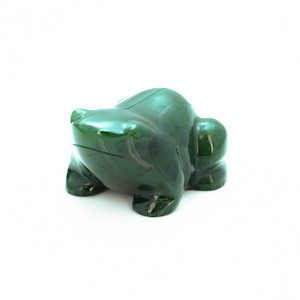
Exploding Barrel: Concept


Monday, January 30, 2017
Spiky Block Programming Challenge
For programming class, we were challenged to make a small level using a "spiky block" mechanic inspired by the Thwomps of Mario Brothers games. I had a really fun time working on this challenge, from making the cute-but-deadly cyclops blocks to coding the dialogue and animations to finding sound effects. Given more time, I probably would animate the facial features of the blocks more (frowning, mouth moving when dialogue changes,) but I'm excited about the result nonetheless.
Here's a glimpse into what the Blueprints for my vertical Spiky Block look like:

Friday, January 27, 2017
Tuesday, January 17, 2017
Platformer: Level Design

Our next project for Game Design class is to create a platformer that begins with a tutorial sequence and then ramps up in difficulty. This is my first pass level design, featuring some notes on the side as to how the mechanics would work and a map of the proposed level. Story-wise, I picture this being in some sort of storm drainage system or water processing facility.
Friday, January 13, 2017
Platformer Tutorial Analysis: Starbound

For Game Design class I chose to deconstruct Starbound's tutorial level, the layout of which is depicted above. In terms of level layout, one nice thing about platformers is that since they eliminate a whole dimension of motion, it's considerably easier to guide and predict player movement than in other games. In Starbound, for example, the player starts on the very left of the tutorial map and their goal is to get to the "end" of the level, which is at the far right. Since they've eliminated the options of going up or down using a floor and ceiling, there's really only one direction to go, so players never feel lost or disoriented. This is perfect for the introductory level, so players can learn their way around the game before being introduced to open areas without such a set linear path. It also ensures that players experience each lesson in a sequential manner that makes sense (learning how to move before you learn how to attack, for example.)

Starbound's intro level is more of a hand-you-instructions than drop-you-in-and-let-you-figure-it-out kind of tutorial, which makes sense to some degree because since it's a PC game, the controls are not as intuitive as they would be on an Xbox. On an Xbox, it would be a fair guess that you use the joysticks to move and the A button to interact with things (as many games do,) but on a PC it would be harder to figure out that you need to use WASD to move (the arrow keys trigger emotes) and press the E key to interact with things. At they very least, there are way fewer buttons to mess around with on an Xbox controller, so it wouldn't take a player long to figure out controls-- whereas having the player try to figure things out by pressing every key on their keyboard would be frustrating and carry the risk of the player missing out on an important mechanic.

The first part of the tutorial focuses on teaching the player several basic mechanics, namely: learning how to move by having the player press A or D to get out of bed, learning how to interact with objects and NPCs by having the player open the door to their room and open their locker, and learning how to equip items by having the player change into their uniform. It's not until after the intro cinematic that obstacles are presented-- first, a wall of dirt which the player must dig through in order to learn how to use their Matter Manipulator (the most important tool in the game,) a roadblock which requires the player to make a detour up to the roof to avoid it in order to learn how to make use of platforms, and a small tentacle monster that the player must defeat in order to learn how to use weapons.

The tutorial level also serves as the exposition for the game, giving the player some amount of backstory and setting up the game's main storyline. The story elements are what help this level to feel more intense and engaging than it really is-- if you think about it, the player isn't really in any danger (it's actually impossible to die in this level,) but they are drawn in by pressures created not through true danger, but implied danger. Earth is being attacked by a huge tentacle monster and people all around you are dying-- elevating the gravity and stakes of the situation past what it might be taken as otherwise.
All of these things in conjunction make this an exciting introduction to Starbound, giving players a little taste of all the things they'll be expected to do in the game as well as the type of story they're in for, and piquing their interest so they continue playing.
All of these things in conjunction make this an exciting introduction to Starbound, giving players a little taste of all the things they'll be expected to do in the game as well as the type of story they're in for, and piquing their interest so they continue playing.
Sunday, November 27, 2016
Cryptid Catchers Commercial
A short 15-second commercial for my 90s-themed all-girl cryptid hunting board game, Cryptid Catchers! The Print-and-Play version is available for download here: http://bit.ly/2fVizlK
Special thanks to Katie Aschman for playing Saga in the commercial and to Brianna Gibson for voice acting!
Monday, October 17, 2016
Tuesday, October 4, 2016
PNP: Playtest #1
I had the opportunity to have some people playtest the rough version of my Print and Play game over the past week, and while I didn't get any pictures, here are some thoughts I came away with:
1. Clarify directions. On the Hazard Cards specifically, some confusion came up because of the wording. The card is meant to be played against an opponent, "casting" its effects on the other player, but since they were worded in "you" form, some players mistakenly assumed when they picked it up that the effects were meant to apply to them. A simple restructure of wording will fix this.
2. Balancing character abilities. Probably because of some of the Hazard Card confusion, the cards weren't put into play as often as I expected, making the characters whose abilities were defense against Hazard Cards less useful than the character whose ability adds to your Hunt Roll. I plan on tweaking this to even it out.
3. Involving Hazard Cards more. During my first playtest session, players almost entirely ignored the Hazard Card mechanic, so for the second session I made collecting Hazard Cards obligatory in the game mechanics (whenever you roll a 1, you must draw a Hazard Card.)
1. Clarify directions. On the Hazard Cards specifically, some confusion came up because of the wording. The card is meant to be played against an opponent, "casting" its effects on the other player, but since they were worded in "you" form, some players mistakenly assumed when they picked it up that the effects were meant to apply to them. A simple restructure of wording will fix this.
2. Balancing character abilities. Probably because of some of the Hazard Card confusion, the cards weren't put into play as often as I expected, making the characters whose abilities were defense against Hazard Cards less useful than the character whose ability adds to your Hunt Roll. I plan on tweaking this to even it out.
3. Involving Hazard Cards more. During my first playtest session, players almost entirely ignored the Hazard Card mechanic, so for the second session I made collecting Hazard Cards obligatory in the game mechanics (whenever you roll a 1, you must draw a Hazard Card.)
Saturday, October 1, 2016
Board Game Mashup
In my Game Design class this week, my friend Niara and I were tasked with using components of two separate board games (Betrayal at House on the Hill and Pass The Pigs)
to create a mashup resulting in an entirely new game. I'll have to
admit it was a bit of a challenge at first, especially considering the
huge difference between our games (one was a very complex horror game
and the other was a very simple, light-hearted game,) but once we got
past the initial hump and into the brainstorming phase, the ideas really
started to flow and the contrast between the games in complexity and
theme really turned into a fun advantage! We ended up having a lot of
fun, and I thought it was really neat that we were able to come up with a
pretty functional, entertaining game in such a short time and with such
strange constraints. Sometimes it takes limiting yourself to bring out
your best ideas. Written up below are the rules for our game Pig Hunt, in which you play as a pig trying to be the first to escape a huge mansion before you become someone's dinner!
MATERIALS:
6 Enemy Tokens
2-4 Player Tokens
23 Room Cards
1 Mystic Elevator Room Card
1 Operating Laboratory Room Card
1 rectangular Entrance Hall Card
20 Item/Event Cards (5 Item, 15 Event)
2 dice numbered 0-2
SETUP:
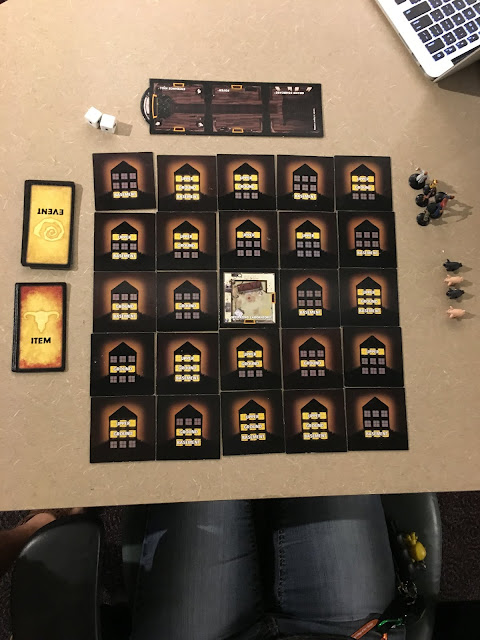
Find and set aside the Mystic Elevator Room Card and the Operating Laboratory Room Card. Shuffle the remaining Room Cards. Put the Elevator Card back into the pile in an arbitrary place, then lay out the cards face-down in a 5x5 grid, making sure to place the Laboratory Card in the center. Place the Entrance Hall Card somewhere beside the main grid. Place the Event and Item cards to the side in separate stacks, face down. Place the player tokens (pig figurines) on the center card and roll to determine who goes first (higher number wins.)
PLAY:
Player One rolls two dice numbered 0-2 to determine how many rooms they can move through. They can move in any cardinal direction they wish, and can change direction in the middle of their turn. Any time a player moves into an undiscovered room, flip over the Room Card and roll one die to check for enemies before moving on. If the die lands on 0, place an Enemy token on the Room Card. If you encounter an Enemy, it ends your turn and any movement left over is denied. At the end of your turn, draw either an Item or an Event card and keep it.

ENEMIES:
You must deal with Enemies when confronted with them. You can do this in one of two ways: by employing an Item or Event card to get rid of the threat permanently, or by attempting to flee without aid.
If you choose to flee, roll the dice as if you were taking a normal turn. You can move in any direction you wish, but the Enemy chases after you, always moving half of however many spaces you move (round down) until they are either dealt with or they encounter another player. If you roll a total of 0, you must stay in the room and it is considered an attack-- put your pig on its side to signify that you've been attacked once. If you remain in the same room as the Enemy for another turn, your pig gets turned on its back and you die, signifying a loss.
Item and Event cards will distract or harm the Enemy so you can get away for good. Employ them before your movement roll to ensure that you are not followed.
If you deal with an enemy through a Card, take the Enemy token off the board to be put back into play again at a later time. If there are no Enemy Tokens available to put into play, ignore the result of your Enemy Check roll.
WINNING:
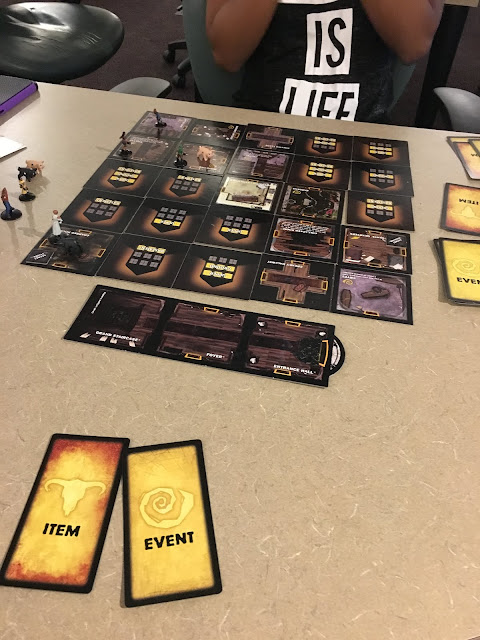
If you discover the Elevator Card, treat it as a normal room and roll to check for Enemies as you enter. If you are on the Elevator Card, you can move in any cardinal direction or choose to move into the Grand Staircase Space of the Entrance Hall. Each Room in the Entrance Hall is treated normally, with Enemies chasing you through the Elevator and down the Hall. The only room that is treated differently is the last room in the Entrance Hall. You must not have an Enemy in the room in order to escape and win the game. If you roll an Enemy Check and discover an Enemy, you must deal with them before being able to escape.
If you roll a number that takes you past the last space in the Entrance Hall, congratulations, you've escaped!
ITEMS & EVENTS:
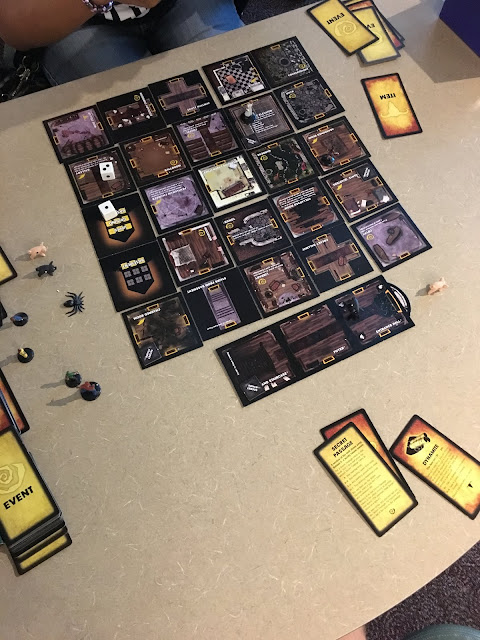
Refer to the list below for Item and Event effects:
Pickpocket's Gloves: Steal a card at random from another player.
Medical Kit: Employ this to counter one Enemy attack, allowing you to survive for one turn longer.
Armor: Employ this to counter one Enemy attack, allowing you to survive for one turn longer.
Secret Passageway: Choose another Room Card on the same floor to travel to. All Enemies following you lose your trail, remove them from the board.
Secret Stairs: Choose another Room Card on the floor above or below you to travel to. All Enemies following you lose your trail, remove them from the board.
Revolving Wall: Choose another Room Card on the same floor to travel to. All Enemies following you lose your trail, remove them from the board.
Mystic Slide: The floor falls out from under you; move down one space. All Enemies following you lose your trail, remove them from the board.
Closet Door: You hide from the Enemy successfully; they get bored and leave. Remove them from the board.
Burning Man: The Enemy is distracted and you get away, remove them from the board.
Debris: The Enemy is distracted and you get away, remove them from the board.
Webs: The Enemy is distracted and you get away, remove them from the board.
Smoke: The Enemy is distracted and you get away, remove them from the board.Spider: The Enemy is distracted and you get away, remove them from the board.
Dynamite: The Enemy is distracted and you get away, remove them from the board.
Footsteps: Check if there is an enemy in an adjacent room before you choose to enter.
Night View: Check if there is an enemy in an adjacent room before you choose to enter.
Something Hidden: Draw an extra Item Card at the end of your turn.
Adrenaline Shot: Move an extra space in any direction.
A Moment of Hope: Sneak a peek at one of the cards on the table. Replace it face down.
It Is Meant To Be: Sneak a peek at one of the cards on the table. Replace it face down.
MATERIALS:
6 Enemy Tokens
2-4 Player Tokens
23 Room Cards
1 Mystic Elevator Room Card
1 Operating Laboratory Room Card
1 rectangular Entrance Hall Card
20 Item/Event Cards (5 Item, 15 Event)
2 dice numbered 0-2

SETUP:
Find and set aside the Mystic Elevator Room Card and the Operating Laboratory Room Card. Shuffle the remaining Room Cards. Put the Elevator Card back into the pile in an arbitrary place, then lay out the cards face-down in a 5x5 grid, making sure to place the Laboratory Card in the center. Place the Entrance Hall Card somewhere beside the main grid. Place the Event and Item cards to the side in separate stacks, face down. Place the player tokens (pig figurines) on the center card and roll to determine who goes first (higher number wins.)
PLAY:
Player One rolls two dice numbered 0-2 to determine how many rooms they can move through. They can move in any cardinal direction they wish, and can change direction in the middle of their turn. Any time a player moves into an undiscovered room, flip over the Room Card and roll one die to check for enemies before moving on. If the die lands on 0, place an Enemy token on the Room Card. If you encounter an Enemy, it ends your turn and any movement left over is denied. At the end of your turn, draw either an Item or an Event card and keep it.

ENEMIES:
You must deal with Enemies when confronted with them. You can do this in one of two ways: by employing an Item or Event card to get rid of the threat permanently, or by attempting to flee without aid.
If you choose to flee, roll the dice as if you were taking a normal turn. You can move in any direction you wish, but the Enemy chases after you, always moving half of however many spaces you move (round down) until they are either dealt with or they encounter another player. If you roll a total of 0, you must stay in the room and it is considered an attack-- put your pig on its side to signify that you've been attacked once. If you remain in the same room as the Enemy for another turn, your pig gets turned on its back and you die, signifying a loss.
Item and Event cards will distract or harm the Enemy so you can get away for good. Employ them before your movement roll to ensure that you are not followed.
If you deal with an enemy through a Card, take the Enemy token off the board to be put back into play again at a later time. If there are no Enemy Tokens available to put into play, ignore the result of your Enemy Check roll.

WINNING:
If you discover the Elevator Card, treat it as a normal room and roll to check for Enemies as you enter. If you are on the Elevator Card, you can move in any cardinal direction or choose to move into the Grand Staircase Space of the Entrance Hall. Each Room in the Entrance Hall is treated normally, with Enemies chasing you through the Elevator and down the Hall. The only room that is treated differently is the last room in the Entrance Hall. You must not have an Enemy in the room in order to escape and win the game. If you roll an Enemy Check and discover an Enemy, you must deal with them before being able to escape.
If you roll a number that takes you past the last space in the Entrance Hall, congratulations, you've escaped!

ITEMS & EVENTS:
Refer to the list below for Item and Event effects:
Pickpocket's Gloves: Steal a card at random from another player.
Medical Kit: Employ this to counter one Enemy attack, allowing you to survive for one turn longer.
Armor: Employ this to counter one Enemy attack, allowing you to survive for one turn longer.
Secret Passageway: Choose another Room Card on the same floor to travel to. All Enemies following you lose your trail, remove them from the board.
Secret Stairs: Choose another Room Card on the floor above or below you to travel to. All Enemies following you lose your trail, remove them from the board.
Revolving Wall: Choose another Room Card on the same floor to travel to. All Enemies following you lose your trail, remove them from the board.
Mystic Slide: The floor falls out from under you; move down one space. All Enemies following you lose your trail, remove them from the board.
Closet Door: You hide from the Enemy successfully; they get bored and leave. Remove them from the board.
Burning Man: The Enemy is distracted and you get away, remove them from the board.
Debris: The Enemy is distracted and you get away, remove them from the board.
Webs: The Enemy is distracted and you get away, remove them from the board.
Smoke: The Enemy is distracted and you get away, remove them from the board.Spider: The Enemy is distracted and you get away, remove them from the board.
Dynamite: The Enemy is distracted and you get away, remove them from the board.
Footsteps: Check if there is an enemy in an adjacent room before you choose to enter.
Night View: Check if there is an enemy in an adjacent room before you choose to enter.
Something Hidden: Draw an extra Item Card at the end of your turn.
Adrenaline Shot: Move an extra space in any direction.
A Moment of Hope: Sneak a peek at one of the cards on the table. Replace it face down.
It Is Meant To Be: Sneak a peek at one of the cards on the table. Replace it face down.
Thursday, September 29, 2016
PNP: Game Theme
In preparation for creating my own Print and Play game, I've been giving a lot of thought to the overall "feel" of the game. I hope to delineate some of those thoughts here in order to have a reference I can look at to make sure every component of the game fits cohesively with the desired end result, which is key to having a memorable experience. Click here to check out my previous post on the subject, where I brainstormed concepts for the game.
CRYPTID CATCHERS
Concept Statement: "The truth is out there... and it's up to you to find it."
The game is centered around the many urban myths and legends that have sprung up over time and become part of American culture, including Bigfoot, Chupacabra, the Jersey Devil, and not to mention UFOs--just to name a few. These legends are often well-known in the communities surrounding them, but it's a very interesting side of our culture that many are unfamiliar with. Although a lot of sightings and evidence over the years have been proven fake, there is undeniably something enticing about the ubiquity of these myths and the old saying that every lie has its roots in some truth... Could these monsters really exist? There's only one way to find out.
Setting:
Inspired in part by The X Files, I really want Cryptid Catchers to retain some of that 90s-era nostalgia that makes the aforementioned show such a delight to watch even twenty years later. The game is set in the continental United States, primarily in rural areas, where players must travel across the country to find convincing evidence of these elusive beings.
Art Style/Mood:
Ideally, Cryptid Catchers will have definitively eerie visuals without crossing the line into flat-out horror, with emphasis on maintaining an air of adventurousness and mystery. I essentially want to echo an experience I had in January of last year, when me and a couple of friends took flashlights and mapmaking tools and explored the sprawling network of drainage pipes underneath our neighborhood. It was a little scary as we encountered broken glass, cockroaches, and deep water, but the overall memory is one of excitement and camaraderie. Much of the "hunting" focuses on isolated nature settings or occasionally gritty urban exploration. Dim lighting and visual effects like fog and deep shadows will be used to convey the element of the unknown. A few reference images for mood can be found below, as well as a pair of possible color palettes (one is a bit lighter in order to take ease of printing into consideration.)


CRYPTID CATCHERS
Concept Statement: "The truth is out there... and it's up to you to find it."
The game is centered around the many urban myths and legends that have sprung up over time and become part of American culture, including Bigfoot, Chupacabra, the Jersey Devil, and not to mention UFOs--just to name a few. These legends are often well-known in the communities surrounding them, but it's a very interesting side of our culture that many are unfamiliar with. Although a lot of sightings and evidence over the years have been proven fake, there is undeniably something enticing about the ubiquity of these myths and the old saying that every lie has its roots in some truth... Could these monsters really exist? There's only one way to find out.
Setting:
Inspired in part by The X Files, I really want Cryptid Catchers to retain some of that 90s-era nostalgia that makes the aforementioned show such a delight to watch even twenty years later. The game is set in the continental United States, primarily in rural areas, where players must travel across the country to find convincing evidence of these elusive beings.
Art Style/Mood:
Ideally, Cryptid Catchers will have definitively eerie visuals without crossing the line into flat-out horror, with emphasis on maintaining an air of adventurousness and mystery. I essentially want to echo an experience I had in January of last year, when me and a couple of friends took flashlights and mapmaking tools and explored the sprawling network of drainage pipes underneath our neighborhood. It was a little scary as we encountered broken glass, cockroaches, and deep water, but the overall memory is one of excitement and camaraderie. Much of the "hunting" focuses on isolated nature settings or occasionally gritty urban exploration. Dim lighting and visual effects like fog and deep shadows will be used to convey the element of the unknown. A few reference images for mood can be found below, as well as a pair of possible color palettes (one is a bit lighter in order to take ease of printing into consideration.)


Subscribe to:
Posts (Atom)